
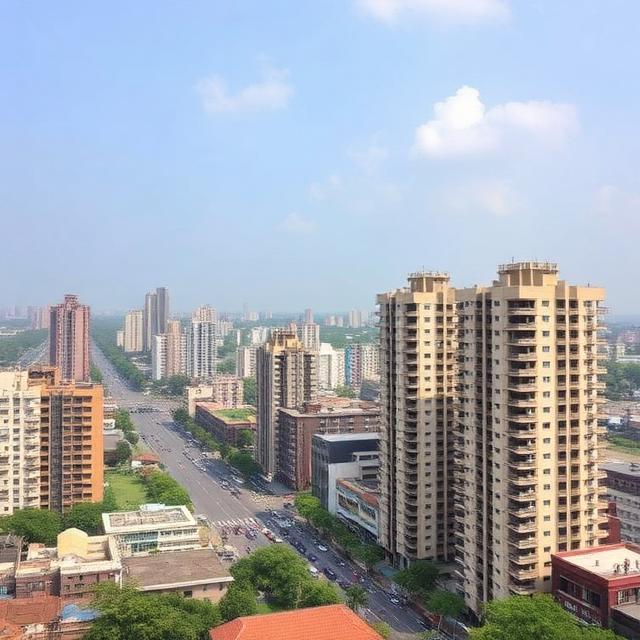
India is witnessing its most consequential urban transition. For the first time, cities are being treated not just as administrative headaches, but as the core “operating system” of the nation’s $5 trillion ambition.
As of February 2026, the Union Budget 2026-27 and the Economic Survey 2026 have signaled a fundamental shift in how we build, fund, and live in our urban centers. Here is a data-driven look at the trends and policies defining India’s urban landscape today.
1. The 2026 Data Snapshot: A Nation in Transition
India is urbanizing at a pace that adds the equivalent of a “new Chicago” to its cities every year.
-
Urban Population: As of February 2026, roughly 37.6% of India (555 million people) resides in urban areas. This is projected to hit 40% by 2030 and 50% by 2047.
-
GDP Engine: While occupying only 3% of the land, cities now generate over 60% of India’s GDP.
-
The Concentration: More than 75% of this urban population remains concentrated in just 10 states, leading to massive infrastructure strain in “Tier-1” metros.
The “Productivity Paradox”
The Economic Survey 2026 highlights a critical concern: “Density without Productivity.” Indian cities are crowded, but they aren’t as economically influential as global peers like Shanghai or Tokyo. This is largely due to:
-
Congestion Costs: In Delhi, the annual cost of congestion for an unskilled worker is estimated between ₹7,200 and ₹19,600 in lost time and wages.
-
Transit Deficit: Nationally, only 47,650 buses serve urban residents, with 61% of them serving just nine megacities.
2. Policy Pivot: From “Smart Cities” to “City Economic Regions”
The 2026 Budget marks the formal evolution from the Smart Cities Mission (which concluded in 2025) to a more integrated regional approach.
The Rise of CERs (City Economic Regions)
The government has introduced City Economic Regions (CERs) to move growth beyond traditional metros.
-
Focus Cities: Seven CERs have been identified for the first phase, including Bengaluru, Pune, Surat, Varanasi, Visakhapatnam, the Bhubaneswar-Puri-Cuttack tricity, and the Coimbatore-Erode-Tiruppur cluster.
-
The Funding Model: Each CER is proposed to receive ₹5,000 crore over five years. Crucially, this is “Reform-cum-Results” based; cities must compete in a “Challenge Mode” to prove they can implement institutional changes.
High-Speed “Growth Connectors”
To promote sustainable passenger systems, the 2026 policy emphasizes seven high-speed rail corridors (e.g., Mumbai-Pune, Hyderabad-Bengaluru) to act as regional connectors, allowing people to live in Tier-2 cities while working in Tier-1 hubs.
3. The Challenges: The “Everyday” Infrastructure Gap
Despite a record ₹12.2 lakh crore capital expenditure boost in 2026, the direct central outlay for urban development actually saw a 11.6% nominal cut. This signals a shift toward making cities financially autonomous.
| Priority Pillar | 2026 Reality Check | Policy Response |
| Mobility | Metro rail takes 33% of urban budget. | Push for PM-eBus Sewa and Congestion Tax pilots. |
| Housing | Slums house ~25% of urban dwellers. | PMAY-Urban 2.0 with a focus on rental housing. |
| Finance | Municipal revenue is only 0.6% of GDP. | Incentives for Municipal Bonds (₹100 Cr per ₹1000 Cr bond). |
| Climate | Frequent floods & heat islands. | Mandatory 20-year City Spatial & Economic Plans. |
4. What’s Next: The Decentralization Mandate
The Economic Survey 2026 makes a bold case for moving from a “Ruler’s Raj” to a “Citizen’s Raj.” * Digital Twins: Cities are being encouraged to use AI-led digital twins for real-time planning of water, traffic, and energy.
-
FSI Reforms: Cities like Chennai are already piloting higher Floor Space Index (FSI) along transit corridors to promote vertical, compact growth rather than horizontal sprawl.
-
Women’s Safety: Replicating Telangana’s “SHE Teams” nationally is a top priority to ensure urban productivity isn’t hindered by safety concerns.
Conclusion
India’s urbanization is no longer an “inevitability” to be managed—it is a “strategic asset” to be built. The transition from Smart Cities to City Economic Regions reflects a maturing policy that values regional economic ecosystems over isolated tech-beautification projects.