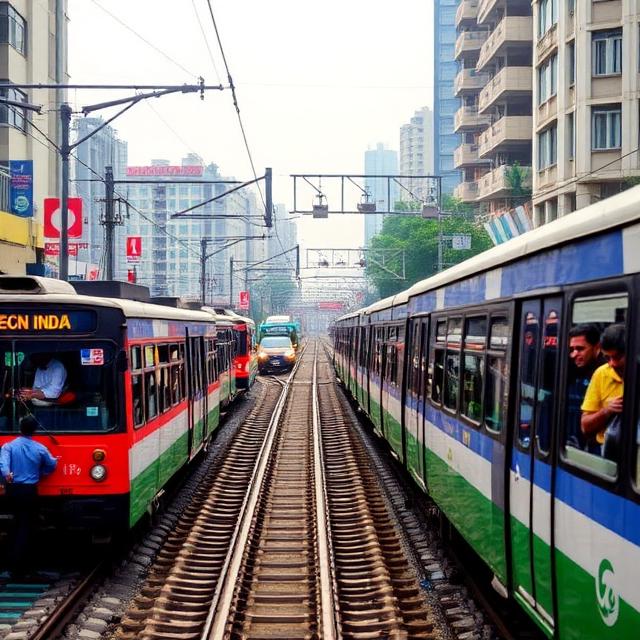
In 2026, the morning commute in an Indian city is a study in contrasts. You might glide through the air on the Kochi Water Metro, board a driverless train on the Delhi Metro Phase IV, or wait twenty minutes for a feeder bus that never arrives.
As India’s urban population heads toward the 600 million mark, the “Mobility Challenge” has evolved. It is no longer just about building more; it is about making the systems we have talk to each other.
1. The Metro Boom: Scaling the Steel Spine
As of early 2026, India has overtaken several developed nations to boast the world’s second-largest operational metro network.
-
The 2026 Budget Push: The Union Budget 2026-27 allocated ₹28,740 crore specifically for metro rail projects. This funding is fueling the “Phase II” and “Phase III” expansions in cities like Lucknow, Pune, and Hyderabad.
-
Beyond the Tier-1s: The most significant trend this year is the “Metro-ization” of Tier-2 cities. Bhopal and Indore have officially joined the ranks of major metro operators, shifting the focus from megacities to regional growth hubs.
-
Vande Metro: A new category of transit—the Vande Metro—is now being rolled out to connect satellite towns (like Meerut to Delhi or Kanpur to Lucknow), bridging the gap between intercity rail and urban rapid transit.
2. The Electric Bus Revolution: Flexibility at Scale
While metros are the spine, buses are the “circulatory system” of the city. In 2026, that system is turning green at a record pace.
-
PM-eBus Sewa: Under this flagship scheme, the government is on track to deploy 10,000 electric buses across 169 cities. In a major 2026 announcement, an additional 4,000 e-buses were sanctioned specifically for the East India Industrial Corridor (Purvodaya initiative).
-
The Payment Security Mechanism (PSM): One of the biggest financial hurdles—private operators fearing payment defaults by cash-strapped state transport departments—was solved in late 2024. The ₹3,435 crore PSM fund now acts as a “guarantor,” bringing private giants like Tata Motors and JBM back to the table with massive fleet commitments.
-
The Efficiency Gap: Despite the tech, the numbers remain low. The benchmark is 60 buses per lakh population, but most Indian cities still operate with fewer than 20.
3. The “Last Mile” Paradox: The Final 500 Meters
You can cross 30 kilometers in 40 minutes on a Metro, but it might take you another 30 minutes to cover the final 1 kilometer to your office. This is India’s most stubborn mobility challenge in 2026.
The Friction Points:
-
Fragmented Planning: In many cities, the metro station and the bus stop are half a kilometer apart, separated by a highway with no pedestrian crossing.
-
The NMT Neglect: Non-Motorized Transport (NMT)—walking and cycling—accounts for nearly 40% of trips in Indian cities, yet receives less than 5% of the urban transport budget.
-
The IPT Factor: Intermediate Public Transport (autos and e-rickshaws) provides the bulk of last-mile connectivity but remains largely unorganized and digitally disconnected from the main transit apps.
4. The Digital Cure: NCMC and One-City Apps
In 2026, the solution to the mobility challenge is increasingly digital.
-
The National Common Mobility Card (NCMC): After years of rollout, the “One Nation, One Card” is finally ubiquitous. You can now use the same Rupay-based card to pay for the Delhi Metro, a BEST bus in Mumbai, and a ferry in Kochi.
-
MaaS (Mobility as a Service): New “Super-Apps” are emerging in cities like Chennai and Bengaluru. These apps integrate metro timings, bus locations, and even e-scooter rentals into a single interface with a unified QR ticket.
Conclusion: What’s Next for 2027?
The “Mobility Challenge” is shifting from a hardware problem to a software problem. We have the trains and we are getting the buses; now, we need the institutional integration.
The next frontier is the Unified Metropolitan Transport Authority (UMTA)—a single body in every city that ensures the bus waits for the metro, the cycle track leads to the station, and the passenger needs only one ticket for the entire journey.