
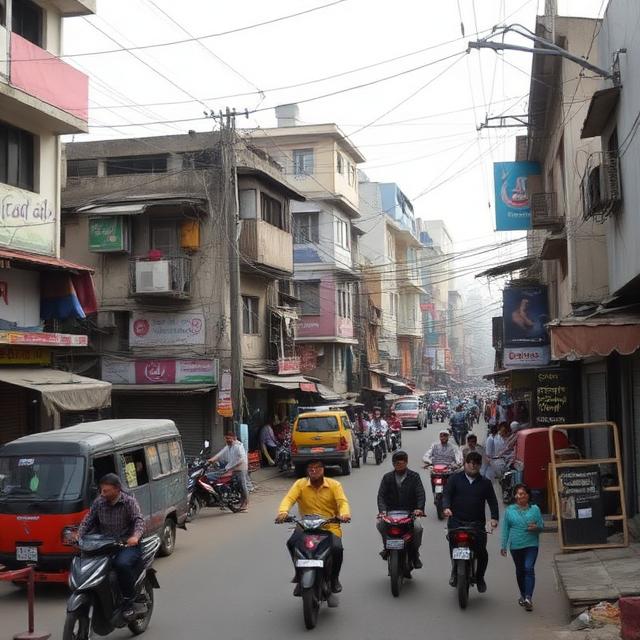
The conversation around Indian urbanization has shifted. We have spent the last decade obsessed with “hard infrastructure”—the flyovers, the metro pillars, and the high-speed rail. But as the Union Budget 2026-27 makes clear with its 11.6% nominal cut in direct urban outlays, the federal government is sending a loud message: the era of the “central grant” is ending. The era of Local Governance has begun.
The “Missing Link” in the success of Indian cities is no longer a lack of engineering or capital; it is the structural weakness of our Urban Local Bodies (ULBs). For a city to thrive, the “hard” infrastructure of concrete must be supported by the “soft” infrastructure of governance.
The Financial Autonomy Crisis
The most significant hurdle to city success in 2026 is the “Begging Bowl” syndrome. Currently, Indian municipal revenue accounts for only 0.6% of the GDP, compared to over 3% in Brazil and 7% in South Africa.
Revenue Stagnation: Most ULBs are unable to cover even their operational costs through their own revenue streams. Property tax collection—the backbone of global municipal finance—remains woefully inefficient in India due to outdated records and manual processes.
The Municipal Bond Revolution: The 2026 policy shift introduces a ₹100 crore incentive for any single municipal bond issuance exceeding ₹1,000 crore. This is a nudge to move cities away from dependence on state hand-outs toward creditworthiness. A city that can govern its finances can build its future.
The Governance Gap: Who is in Charge?
In 2026, the governance of an Indian city is often a “fragmented mess.” A single street might be managed by the Municipal Corporation, while the water belongs to a state board, and the electricity to a private utility, with the Metro authority operating independently of all of them.
The Mayor Problem: Unlike London or New York, most Indian mayors are ceremonial figures with short tenures and limited executive power. The real power often sits with state-appointed commissioners. This leads to a “Political Accountability Deficit.”
Integrated Planning: The new City Economic Region (CER) framework, funded with ₹5,000 crore per region in 2026, aims to solve this by mandating unified planning. It forces diverse agencies to sit at one table, ensuring that when a road is built, the sewage pipes are laid before the tar is poured, not after.
System Strengthening: The Chaos Theory Approach
To bridge the governance gap, we must look at cities as Complex Adaptive Systems rather than static machines.
Feedback Loops and Data: Governance succeeds when it is “responsive.” In 2026, the use of Digital Twins—virtual replicas of cities—is becoming a governance tool. By monitoring real-time user data and performance metrics, city managers can utilize Negative Feedback Loops to self-correct issues (like a water leak or traffic bottleneck) before they amplify into major failures.
Encouraging Self-Organization: Strengthening a city involves moving from rigid, top-down hierarchies to decentralized structures. Strengthening Ward Committees allows neighborhoods to self-organize in response to local threats, whether it is a heatwave or a waste management crisis.
The 2026 Strategic Lens: From Projects to People
Governance is the “Dharma” (purpose) behind the “Data.” To move from linear management to natural methodologies, city leaders are adopting the Enhance ➔ Perturb ➔ Attract ➔ Excite lens:
-
Enhance: Strengthen information sharing between citizens and the state.
-
Perturb: Stress-test systems through “Chaos Engineering” to ensure resilience against climate shocks.
-
Attract: Rally the city around a compelling, inclusive vision.
-
Excite: Fuel the transition with a sense of collective ownership.
Conclusion: The Path to 2047
As we plan for 500 million more urban citizens, we must realize that a city without strong governance is just a collection of buildings. The “Missing Link” is the empowerment of our local leaders and the professionalization of our municipal staff.
Success in 2047 will not be defined by who has the tallest building, but by which city has the most transparent, accountable, and financially solvent governance system. It is time to stop building projects and start building institutions.