
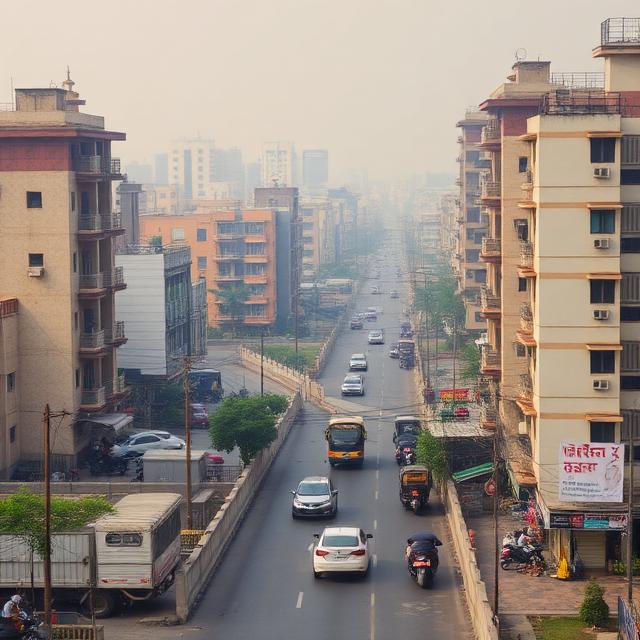
In the narrative of modern India, a curious paradox has emerged by early 2026. On one hand, you have the Atal Setu, a 21.8 km engineering marvel that rivals the best sea bridges in the world. On the other, the commute from the bridge’s exit to a resident’s home in Mumbai can still take forty minutes due to a single waterlogged pothole or a poorly timed traffic light.
This is the Infrastructure Paradox: India is successfully building “Grand Assets” (the Macro) while struggling to fix “Local Bottlenecks” (the Micro).
1. The Macro Triumph: A Golden Age of Assets
The scale of India’s capital expenditure is undeniable. With the 2026-27 Budget allocating ₹12.2 lakh crore to Capex, the “Big Picture” infrastructure is reaching a point of maturity.
-
Expressways: The Delhi-Mumbai Expressway is no longer a dream; it’s a high-speed reality that has slashed travel time for freight by nearly 50%.
-
Aviation: With the inauguration of the Noida International Airport (Jewar), India now boasts one of the world’s most modern aviation hubs, designed to handle 70 million passengers annually.
-
Digital Spine: Through the PM Gati Shakti National Master Plan, the government has mapped over 1,400 layers of data, ensuring that major projects are planned with surgical precision.
2. The Micro Struggle: The “Last Mile” Bottleneck
While you can now zip between cities at 120 kmph, the “First and Last Mile” remains the Achilles’ heel of the Indian economy.
The Urban Mobility Trap
India’s Tier-1 cities are suffering from a “Transit Mismatch.” We have built world-class Metro rails, but the walk from the Metro station to the office is often through broken pavements or non-existent feeder bus networks.
-
The Cost: Estimates suggest that congestion in India’s top four cities costs the economy roughly $22 billion annually in wasted fuel and lost productivity.
The Logistics “Friction”
Even with Dedicated Freight Corridors (DFC), the transition from the rail-head to the local warehouse is fraught with inefficiency.
-
The Paradox: A container can travel 1,000 km on a train in 18 hours, only to spend 12 hours sitting in a suburban traffic jam trying to reach a distribution center.
3. Why Does the Paradox Exist?
To understand how to fix it, we have to look at the structural divide in Indian governance:
| Feature | The Macro (National) | The Micro (Local) |
| Authority | Central Government / NHAI | Municipal Corporations / ULBs |
| Funding | Robust (Union Budget/Global Bonds) | Fragile (Property Tax/State Grants) |
| Planning | GIS-mapped & Centralized | Fragmented & Reactive |
| Speed | 37 km/day (Highways) | Years for a single flyover |
4. Bridging the Gap: The 2026 Strategy
The government’s strategy is now pivoting from “Creation” to “Integration.” The focus for the rest of this decade is shifting toward:
A. The “Sponge City” Initiative
To stop the annual paralysis caused by monsoons, the 2026 urban planning guidelines mandate Permeable Paving and Urban Forests in all new Smart City projects. The goal is to ensure that world-class roads don’t become world-class rivers every July.
B. Unified Logistics (ULIP)
By integrating the Unified Logistics Interface Platform, every stakeholder—from the massive shipping line to the local truck driver—is on the same digital page. This reduces the “documentation friction” that causes local delays at state borders and city entry points.
C. The Rise of Transit-Oriented Development (TOD)
New urban laws are encouraging high-density residential and commercial zones within 500 meters of Metro stations. This effectively eliminates the “Last Mile” problem by bringing the destination to the infrastructure.
The Verdict
India has proven it can build the “Big Things.” The next phase of the Indian miracle won’t be measured in the length of its bridges, but in the efficiency of its intersections. The paradox will only be solved when the “local” reflects the “world-class” standards of the national.