
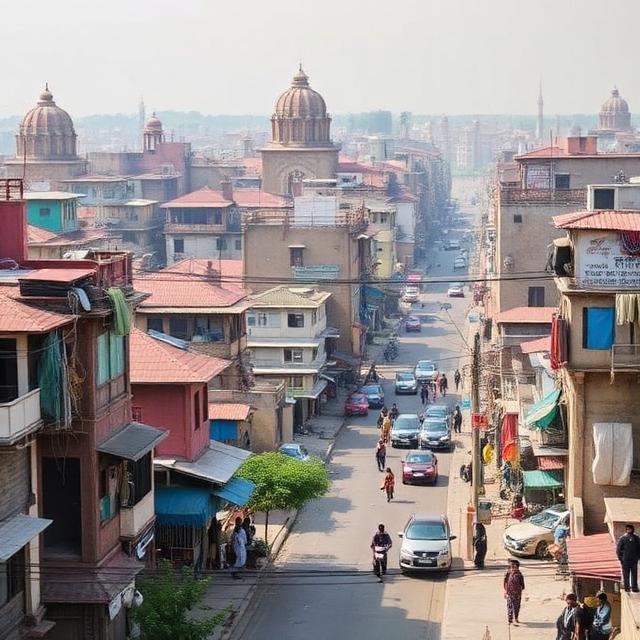
The “Economics of Urban Development” in India is no longer just about building roads and pipes; it is a high-stakes strategy to convert urban density into global productivity.
As of February 2026, the Union Budget 2026-27 and the Economic Survey 2025-26 have signaled a shift. With India now the world’s fourth-largest economy, the focus has moved from “Smart Cities” to City Economic Regions (CERs)—a move designed to ensure that the next phase of growth isn’t just bigger, but richer.
1. The GDP Engine: Concentration vs. Productivity
Indian cities are the primary drivers of the nation’s wealth, but they face a “Productivity Paradox.”
-
Disproportionate Output: While cities occupy only 3% of India’s land, they contribute nearly 60% of the national GDP.
-
The Top Heavy Reality: The top 50 cities alone contribute roughly 40% of India’s GDP, led by Delhi NCR ($186B), Mumbai ($162B), and Bengaluru ($112B).
-
The Congestion Tax: The Economic Survey 2026 identifies “congestion” as a literal tax on the poor. In Delhi, the annual cost of congestion for an unskilled worker is estimated between ₹7,200 and ₹19,600 in lost wages and productivity.
2. Financing the $840 Billion Gap
The World Bank estimates India needs $840 billion (₹70 lakh crore) by 2036 to meet its urban infrastructure needs. To bridge this, the 2026 fiscal strategy emphasizes self-reliance over central grants.
A. The 16th Finance Commission Grant
The grant for Urban Local Bodies (ULBs) has been more than doubled to ₹3,56,257 crore for the 2026-31 period. Crucially, 52% of these grants are “untied,” giving cities unprecedented freedom to fix “first-mile” infrastructure like local drains and footpaths.
B. Municipal Bonds and Asset Monetization
The government is nudging cities to behave like corporations:
-
Bond Incentives: A new incentive of ₹100 crore is offered for any single municipal bond issuance exceeding ₹1,000 crore.
-
CPSE REITs: The government is “recycling” public sector land and assets through Real Estate Investment Trusts (REITs) to unlock dormant capital for new construction.
-
Risk Guarantee Fund: An Infrastructure Risk Guarantee Fund has been set up to give private developers the confidence to invest in high-risk urban projects.
3. The CER Shift: Mapping Economic Drivers
The most significant policy of 2026 is the City Economic Region (CER) framework.
-
The Pilot Outlay: Each identified CER (like the Prayagraj-Varanasi-Ayodhya circuit or the Bhubaneswar-Cuttack cluster) will receive ₹5,000 crore over five years.
-
The Challenge Mode: This isn’t a handout. Cities must compete in a “Challenge Mode,” proving they can implement reforms in land-use, digital property records, and municipal finance to win the funds.
-
Growth Connectors: Seven High-Speed Rail corridors (e.g., Delhi-Varanasi, Hyderabad-Bengaluru) are being developed to turn these CERs into a single, commutable economic network.
4. The “Orange Economy”: Cities as Cultural Hubs
The Economic Survey 2026 introduces a new growth lever: the “Orange Economy” (creative and cultural sectors).
-
The Concert Multiplier: Live entertainment and concerts are being viewed as high-multiplier urban services. The survey notes that a single major international concert can generate economic value well beyond ticket sales, boosting local hospitality, transport, and logistics.
-
Single-Window Clearance: To facilitate this, a Single Window Mechanism for Live Entertainment is being rolled out to turn Indian cities into global cultural destinations.
Conclusion
The economics of 2026 is about moving from “Horizontal Sprawl” to “Vertical Productivity.” By incentivizing higher FSI (Floor Space Index) and pushing for Municipal Self-Reliance, India is trying to ensure that its cities are not just places where people live, but where capital efficiently multiplies.