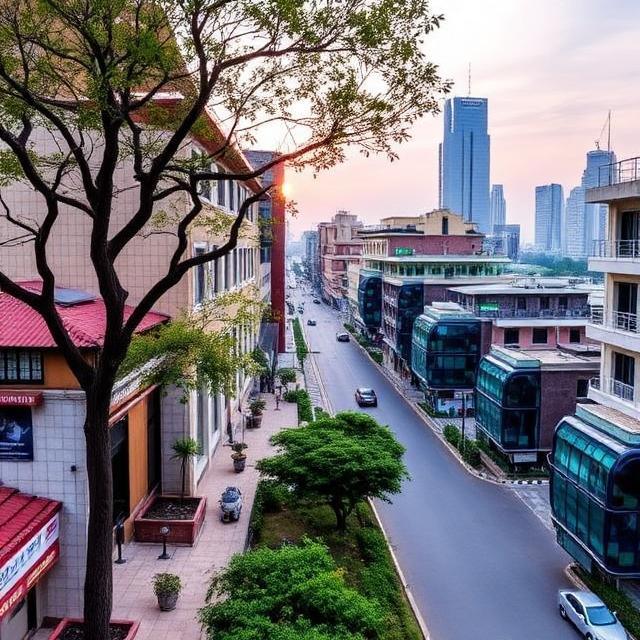
The global conversation around cities has shifted from “How big?” to “How resilient?” For India, this isn’t just a philosophical debate; it’s a survival strategy. With the Union Budget 2026-27 introducing the concept of City Economic Regions (CERs) and allocating ₹5,000 crore for urban infrastructure in a “challenge mode,” the vision for sustainable urban development is becoming more granular and result-oriented.
However, moving from vision to reality involves navigating a landscape of reduced central outlays—an 11.6% cut this year—and a growing urgency to combat climate-induced stresses like heatwaves and flash floods.
1. The New Blueprint: City Economic Regions (CERs)
The 2026 strategy marks a departure from isolated “Smart Projects” toward integrated economic ecosystems.
-
The Concept: Instead of looking at a city as a standalone unit, CERs integrate multiple urban centers—including Tier-2 cities and temple towns—into unified hubs of productivity.
-
The “Challenge Mode”: Financing is now reform-cum-results based. Cities must compete for funds by proving they can implement sustainable reforms, such as land-value capture and improved municipal revenues.
-
Regional Decentralization: By empowering Tier-2 and Tier-3 cities, the government aims to ease the “over-saturation” of megacities like Bengaluru and Mumbai, creating new sustainable growth nodes.
2. Climate Resilience: The “Sponge City” Reality
Sustainable development in 2026 is synonymous with climate adaptation. After years of urban flooding, India is finally adopting Green-Blue Infrastructure.
-
Sponge City Framework: Cities like Shanghai have provided the blueprint, but Indian cities are now localizing it. By expanding Ramsar sites (98 sites as of 2026) and protecting urban wetlands, cities are using nature to absorb excess monsoon rain.
-
Urban Forests (Miyawaki Method): Cities like Hyderabad and Pune have pioneered dense micro-forests to combat the Urban Heat Island effect, successfully lowering localized temperatures by 1–2°C.
-
Net-Zero Goal: Under the Climate-Smart Cities Assessment Framework (CSCAF) 2.0, over 80 cities are now tracking their carbon footprints, aiming for a net-zero transition by 2070.
3. Sustainable Mobility: Beyond the Metro
While Metro Rail consumes nearly one-third of urban allocations in 2026 (₹28,740 crore), the sustainability vision is widening to include more inclusive transit.
-
The e-Bus Surge: The PM-eBus Sewa scheme is the backbone of clean air initiatives, with over 10,000 electric buses approved across 169 cities to reduce vehicular emissions.
-
Transit-Oriented Development (TOD): 20-year City Spatial and Economic Plans are now being mandated for million-plus cities, ensuring that housing and commercial hubs are clustered around transit corridors to reduce the need for private cars.
-
NMT (Non-Motorized Transport): A persistent gap remains, but “pedestrian-first” plazas and dedicated cycling lanes are finally being integrated into CER planning to bridge the last-mile connectivity hurdle.
4. The Challenges: What’s Holding Us Back?
The transition to reality is fraught with structural bottlenecks:
-
The Funding Crunch: The 11.6% cut in central urban outlays puts more pressure on already fiscally weak Urban Local Bodies (ULBs). Without greater fiscal devolution, sustainable projects often remain on the shelf.
-
Administrative Silos: Missions like AMRUT 2.0 and the Smart Cities Mission often work in silos. Integrating water management, transport, and greening into a single master plan remains a governance challenge.
-
The “Grey” Infrastructure Bias: There is still a tendency to favor “concrete” solutions (flyovers and sea links) over “green” ones (mangrove restoration or permeable paving) due to their immediate visibility.
The Verdict: The 2026 Pivot
Sustainable urban development in India has moved past the “awareness” stage. We have the digital command centers, we have the e-buses, and we have the sponge city pilots. The “reality” of 2047 will depend on whether we can scale these solutions beyond “Smart Enclaves” and into the everyday fabric of our growing Tier-2 and Tier-3 cities.