
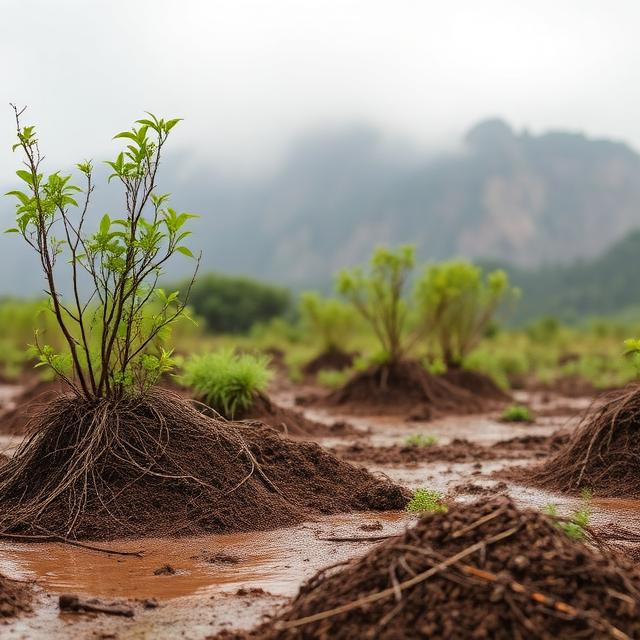
The global dialogue around climate change has moved past the “physical” crisis to confront the “structural” one. We are no longer just measuring the rising tide in centimeters; we are measuring it in the widening chasm between the global elite and those living at the world’s geographical and economic margins.
The World Inequality Report 2026 has made one truth undeniable: Climate change is the ultimate inequality multiplier.
Resilience at the Margins: How Climate Change Is Reshaping Inequality
If 2025 was the year of climate “pledges,” 2026 is the year of climate “reality.” The latest data reveals a world where the wealthiest 10% are responsible for 77% of emissions linked to private capital, while the bottom 50%—who contribute just 3%—are facing the frontline of a crisis they didn’t create.
1. The “Risk Society” Paradox
We have entered what sociologists call a “Risk Society,” but the risks are anything but democratic. While the global elite use their wealth to “insulate” themselves from environmental shocks, marginalized populations are being pushed into a cycle of Permanent Recovery.
-
The Adaptation Trap: In developing nations, every dollar spent on rebuilding after a flood is a dollar taken away from education or healthcare. This creates an “investment trap” where rising disasters lead to increased indebtedness, making it harder for communities at the margins to ever truly adapt.
-
The “Two-Millimeter” Mirage: While global sea levels rise at an average of 2–3mm per year, local “non-climatic factors” like land subsidence in informal coastal settlements can make the lived reality feel ten times worse.
2. Intersectional Vulnerability: When Identities Overlap
In 2026, we have learned that vulnerability is not a single layer. It is a complex web of intersecting identities—gender, race, disability, and geography.
-
The Gender Pay & Climate Gap: New data shows that when unpaid labor is included, women earn only 32% of men’s income globally. This economic fragility means that when a climate disaster hits, women have fewer resources to relocate, less access to credit, and higher burdens of “invisible” care work during the recovery.
-
Informal Workers: In the “mega-cities” of the Global South, millions of informal outdoor workers are structurally excluded from formal protection. For a street vendor in Vietnam or a waste picker in Brazil, a heatwave isn’t just a health risk—it’s an immediate loss of the “freedom to be healthy.”
3. Resilience as a Social Architecture
The breakthrough of 2026 is the realization that Resilience is not a “tech fix”; it is a “social fix.” | Resilience Pillar | The Old Way (Technocratic) | The New Way (Socially Inclusive) | | :— | :— | :— | | Finance | Top-down loans and “Offset” credits. | Direct Grants to Indigenous & local leaders. | | Infrastructure | Concrete sea walls and “Hard” barriers. | Nature-Based Solutions (NbS) managed by communities. | | Policy | “GDP-centered” growth models. | Social Protection Floors that cushion climate shocks. |
The 2026 Shift: We are seeing a move toward Adaptive Social Protection. This means that cash transfers and healthcare are now being linked directly to climate-risk data, ensuring that “the margins” have an income floor before the storm arrives, not just a cleanup crew after it leaves.
4. Indigenous Sovereignty: The Original Resilience
In 2026, Indigenous Peoples are finally being recognized not as “vulnerable groups,” but as Strategic Leaders. * The Guardians of Biodiversity: Indigenous groups protect 25% of the world’s land but receive less than 1% of climate finance. The “Climate Justice” movement of 2026 is fighting to flip this script, moving decision-making power to the communities who have practiced “Resilience at the Margins” for millennia.
Conclusion: Bridging the Gap
Resilience is not the ability to “bounce back” to a broken status quo; it is the ability to “leap forward” into a more equitable system. In 2026, a climate strategy that doesn’t address inequality isn’t just unfair—it’s scientifically incomplete.
We cannot build a resilient planet on a foundation of systemic exclusion. The only way to save the center is to protect the margins.
Is your climate strategy leaving the margins behind?
The transition to a stable climate must be a Just Transition, or it won’t be a transition at all.