
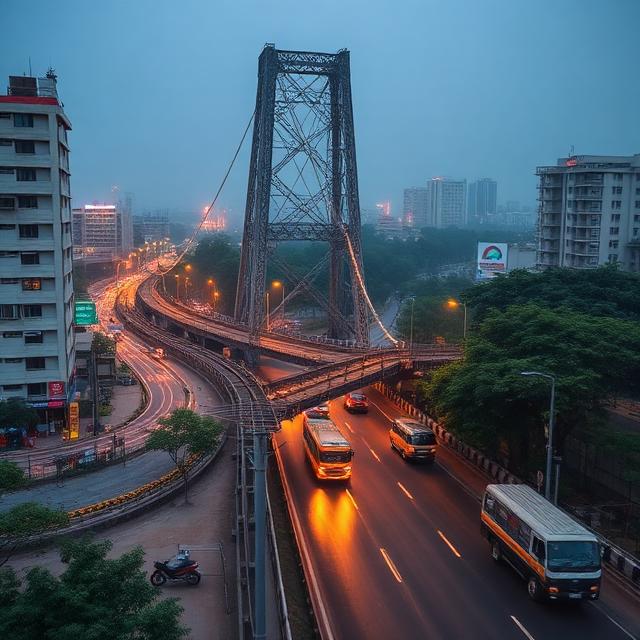
In the newly released Union Budget 2026-27, the Indian government signaled that its multi-year infrastructure marathon is entering a “confidence-driven” phase. With a record capital expenditure (Capex) target of ₹12.2 lakh crore ($147 billion), the focus has shifted from merely laying asphalt to building a sophisticated, integrated ecosystem of industrial corridors and future-ready cities.
As of February 2026, here is the breakdown of how India is rewriting its physical and economic geography.
1. The Capex Surge: Spending for the “Viksit Bharat” Goal
The 2026 Budget has upped the ante, increasing the infrastructure outlay by roughly 9% over last year’s ₹11.1 lakh crore. This sustained spending has successfully crowded in private investment, which had been sluggish for years.
-
Infrastructure as % of GDP: Public Capex now touches an all-time high of 4.4% of GDP.
-
The Risk Factor: To entice even more private capital, the government launched the Infrastructure Risk Guarantee Fund. This fund offers partial credit guarantees to lenders, de-risking the “heavy lifting” phase of construction where projects often stall.
-
Multiplier Effect: Estimates suggest that every rupee invested in these assets is generating a return of ₹3.25 to the broader economy through jobs and improved trade efficiency.
2. Corridors of Power: The New Economic Arteries
The National Industrial Corridor Programme (NICP) has expanded to include 11 major corridors with 32 projects in various stages of development. The goal is simple: move goods faster and cheaper.
The Purvodaya Push (Eastern India)
The 2026 Budget placed a massive bet on India’s eastern states—Odisha, Andhra Pradesh, Bihar, and West Bengal—to turn the “mineral belt” into a “manufacturing belt.”
-
East Coast Economic Corridor (ECEC): New allocations have accelerated the Vizag-Chennai and Odisha Economic Corridors.
-
Rare Earth Corridor: A first-of-its-kind dedicated corridor for rare earth minerals was announced for Odisha and Andhra Pradesh to support the global semiconductor and EV supply chain.
-
Freight Backbone: The Dedicated Freight Corridors (DFCs) are now largely operational, allowing cargo trains to bypass passenger lines and maintain speeds of 60–70 kmph, compared to the previous 25 kmph average.
The Logistics Milestone
For the first time in India’s history, logistics costs have officially dipped below the 8% of GDP mark (recorded at 7.97% in the 2025-26 Economic Survey). This is a direct result of PM Gati Shakti, the digital “brain” that coordinates 57 ministries to ensure that roads, rails, and ports are built in sync.
3. Cities in Transition: Beyond the Smart Cities Mission
With the original Smart Cities Mission officially concluding in March 2025, the focus has pivoted to Urbanization 2.0. The challenge has moved from “tech-enabled pockets” to “livable city-wide systems.”
-
University Townships: A standout 2026 Budget announcement was the creation of 5 university townships located near major industrial and logistics hubs. These are designed to bridge the skill gap by training “smart city” planners and logistics managers on-site.
-
Tier-2 and Tier-3 Rise: The focus has shifted to cities like Indore, Surat, and Lucknow, which are seeing massive investments in Integrated Command and Control Centres (ICCCs) to manage traffic and waste in real-time.
-
The Resilience Gap: Despite the boom, urban flooding remains a stubborn bottleneck. The 2026 framework introduces stricter “green cover” norms and incentives for cities that implement sponge city designs to combat monsoon chaos.
4. The Digital & Green Overlay
Infrastructure in 2026 isn’t just concrete; it’s code and carbon-neutrality.
-
Green Logistics: Over 100 Gati Shakti Cargo Terminals are now operational, many powered by renewable energy, helping Indian Railways reduce its carbon footprint while tripling freight revenue.
-
DPI Integration: The Unified Logistics Interface Platform (ULIP) now connects 44 different systems, allowing a manufacturer in Haryana to track their cargo from factory floor to a ship in Singapore using a single digital ID.
The Verdict
India’s infrastructure push has successfully solved the “Long Haul” problem—highways and freight corridors are world-class. The next four years will be about solving the “Last Mile” and the “Urban Crisis.” If the current pace of 3.5% annual growth in infrastructure output holds, India is well on its way to becoming the world’s third-largest economy by the end of this decade.