
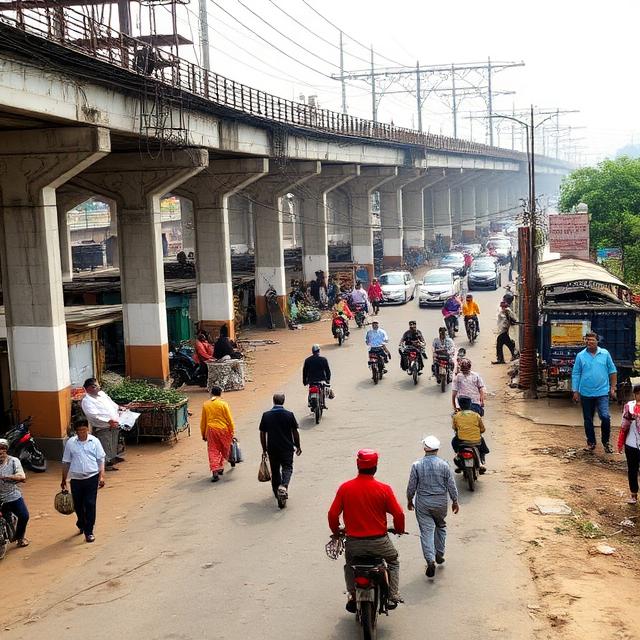
India is often described as a “global construction site.” We celebrate the ₹12.2 lakh crore poured into expressways, high-speed rail, and mega-ports. But if you look away from the gleaming asphalt of the Delhi-Mumbai Expressway and toward the primary health center in a Tier-3 town or a municipal school in a crowded urban pocket, a different story emerges.
This is the “Social Infrastructure Lag”—the widening gap between the world-class physical assets we build and the human capital systems required to run them.
1. The Expenditure Imbalance: Steel vs. Skills
The numbers tell a story of lopsided priorities. While the 2026-27 Union Budget reached a historic high for physical Capex (roughly 4.4% of GDP), the allocation for social sectors remains significantly lower.
-
Education: Total spend hovers around 4% of GDP, still short of the long-standing 6% target set by the National Education Policy (NEP).
-
Healthcare: Public health spending is struggling to reach the 2.5% of GDP goal, currently sitting closer to 2.1%.
While physical infrastructure has a high “visibility” factor (you can see a bridge being built), social infrastructure is “invisible” and takes decades to yield returns. The result? A nation with 21st-century roads but 20th-century primary care.
2. The “Building” vs. “Outcome” Trap
In India, we are excellent at building the shell, but we often fail the system inside.
-
The School Paradox: Under missions like PM-SHRI, thousands of schools have been “upgraded” with smart boards and labs. However, the learning poverty remains. A 2025-26 survey indicated that while enrollment is at an all-time high, foundational literacy and numeracy (the ability to read a basic second-grade text) haven’t kept pace with the hardware upgrades.
-
The Hospital Paradox: We have more medical colleges and Ayushman Bharat health accounts (over 84 crore) than ever before. Yet, the “out-of-pocket” expenditure for a middle-class family facing a chronic illness remains one of the highest in the world because the quality of free public care hasn’t scaled with the access to it.
3. Why Does Social Infra Lag?
Three structural “friction points” explain why a highway is easier to build than a healthcare system:
-
Jurisdictional Overlap: Roads are often managed by the Center (NHAI). Education and Health are State subjects. This leads to a fragmented delivery where a Central scheme might provide the funds, but the State-level execution lacks the administrative “muscle.”
-
The Maintenance Deficit: Physical assets are “one-time” builds. Social assets require recurring human capital. You can build a clinic in six months, but training a specialized doctor takes ten years.
-
The “Silo” Problem: We build “University Townships” (a 2026 highlight), but they are often disconnected from the industrial corridors they are meant to serve, leading to a “skilled but unemployed” workforce.
4. The 2026 Pivot: Moving from “Assets” to “Intelligence”
Recognizing this lag, the current policy shift is moving toward Digital Social Infrastructure.
-
IIT Creator Labs & AI Ready Schools: Instead of just building classrooms, the government is betting on AI-integrated learning to bridge teacher shortages.
-
The “Bio-Revolution”: Budget 2026 introduced massive support for Biopharma and Gene-based therapies to reduce the cost of chronic disease treatment—shifting the focus from just “beds” to “cures.”
-
The Urban Local Body (ULB) Reform: For the first time, funding for cities is being tied to their ability to improve social indicators like air quality and waste management, not just road length.
Conclusion: The Final Frontier
A nation cannot ride to superpower status solely on high-speed rails if the passengers aren’t healthy or educated enough to drive the economy. The “Gati Shakti” (Speed of Power) for roads must now be matched by a “Manav Shakti” (Power of Humans) for people.
The highways are ready; the question is, are we investing enough in the people who will travel on them?