
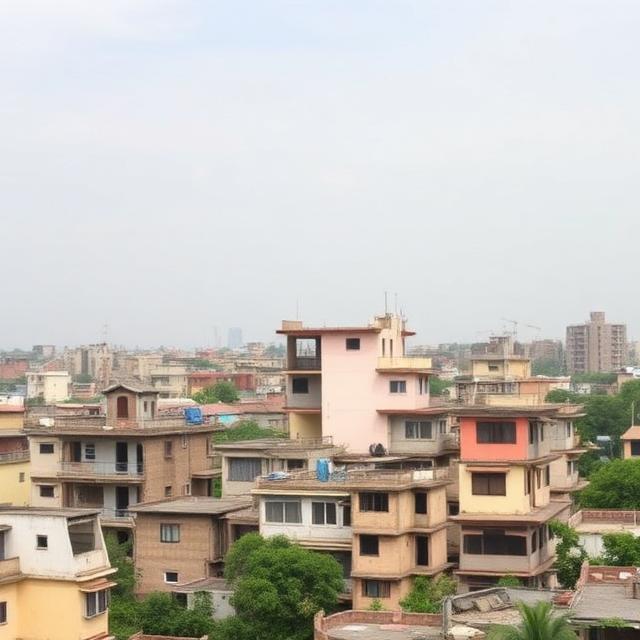
In the narrative of India’s economic ascent, the quest for a permanent roof remains the most deeply personal milestone for millions. As of February 2026, the government’s “Housing for All” mission has entered its second decade, marked by a massive infusion of capital and a shift in policy focus.
In the recently tabled Union Budget 2026-27, the government scaled up its rural housing funding to ₹54,917 crore while maintaining a steady pulse on urban demand. However, beneath the blockbuster numbers lies a sector in transition—where the gap between “sanctioned houses” and “affordable reality” remains a critical challenge.
1. The Policy Backbone: PMAY Urban 2.0 and Gramin
The Pradhan Mantri Awas Yojana (PMAY) remains the central pillar of India’s housing strategy. By early 2026, the mission has evolved into its second phase, focusing on deeper penetration into Tier-2 and Tier-3 cities.
-
PMAY-Urban 2.0: With an allocation of ₹18,625 crore in the 2026-27 Budget, the focus has shifted toward interest subvention for the middle class and slum redevelopment. As of November 2025, over 96 lakh homes have been delivered in urban areas.
-
PMAY-Gramin: The rural wing has seen a significant boost, aiming for an additional 2 crore houses by 2029. The unit cost assistance has been adjusted to reflect rising material costs (cement and steel), ensuring that “affordable” doesn’t mean “substandard.”
-
Interest Subvention (CLSS): While the Credit Linked Subsidy Scheme (CLSS) remains a powerful tool, industry experts in 2026 are calling for a revision of the ₹45 lakh price cap, which many argue is no longer realistic in major metros like Mumbai or Bengaluru.
2. Progress Made: By the Numbers (2026 Update)
The scale of execution in the last decade has been unprecedented in India’s history.
| Metric | Status (as of early 2026) |
| Total Houses Completed (Urban + Rural) | ~4.21 Crore+ |
| PMAY-U Delivery Rate | 78% of sanctioned houses |
| Rural Target (New Phase) | 2 Crore additional units by 2029 |
| Housing Credit as % of GDP | ~11% (reflecting high financialization) |
3. Persistent Gaps: The Reality of 2026
Despite the monumental progress, “Affordable Housing” is facing a structural crisis. According to ANAROCK data, the sales share of affordable homes has plummeted from 38% in 2019 to just 18% in 2025.
A. The “Outdated Definition” Problem
The current definition of affordable housing—units priced under ₹45 lakh with a size cap of 60 sq. meters in metros—was set in 2017. In 2026, land and construction costs have risen by nearly 40%.
-
The Consequence: Developers are shying away from this segment because profit margins (10-12%) are half of what they can earn in the luxury segment (25-30%).
B. The Peripheral Trap
Affordable housing is increasingly being built on city outskirts where land is cheap.
-
The Living Cost Paradox: A family might get an affordable house 40km from the city center, but they spend 30% of their income on commuting to work. Without integrated “City Economic Regions” (CERs), these houses often remain vacant “ghost townships.”
C. The Stalled Project Legacy
While the SWAMIH Fund has helped revive thousands of stalled units, as of 2026, nearly 9.4 million urban homes are still needed to bridge the current shortage. The gap is projected to hit 30 million by 2030 if private participation doesn’t return to the budget segment.
4. What’s Next: The 2026-2030 Roadmap
The government’s strategy for the next four years is moving from “Building Units” to “Building Ecosystems.”
-
Rental Housing Mission: Following industry pressure, 2026 may see the launch of a National Rental Housing Mission. This aims to formalize the rental market, providing tax incentives for developers to build “dormitory-style” housing for the urban migrant workforce.
-
Municipal Bonds for Infra: Cities are being encouraged to raise their own funds to build the water and sewage lines that make affordable housing viable, rather than waiting for Central grants.
-
Modern Construction Tech: The use of 3D Volumetric Printing and pre-cast technology is being incentivized to reduce construction timelines from years to months.
Conclusion
Affordable housing in India is no longer just a welfare scheme; it is economic infrastructure. While the PMAY mission has provided millions with dignity, the “missing middle” of urban India—the young professional and the factory worker—is still being priced out of the market.
To bridge the gap by 2047, India must move beyond the ₹45 lakh cap and treat housing as part of a larger “Transport-Job-Home” continuum. The foundation is laid; the next floor requires more than just concrete—it requires fiscal innovation.