
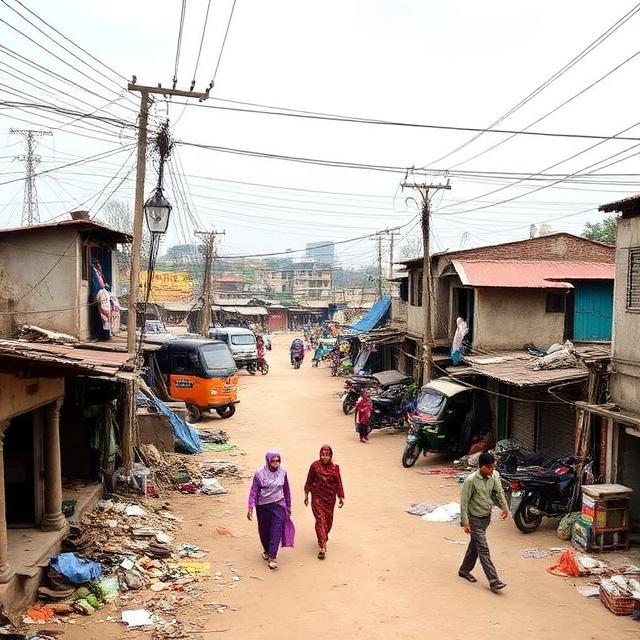
The skyline of a typical Indian city is a study in vertical inequality. For every glass-walled skyscraper housing a global tech hub, there is a shadow cast over a sprawling informal settlement below.
While the Economic Survey 2025-26 highlights that multidimensional poverty has plummeted to roughly 11.28% (with extreme poverty near 5.3%), the “Urban Poverty Paradox” is becoming harder to ignore. Our cities are getting richer, but the “invisible hands”—the gig workers, domestic help, and construction laborers—are increasingly squeezed by rising costs and climate vulnerability.
1. The Data: Beyond the Percentages
National statistics often paint a rosy picture, but for the urban poor, the reality is one of “High Costs, Low Security.”
-
Slum Reality: As of early 2026, an estimated 236 million people—nearly half of India’s urban population—reside in slums or informal settlements.
-
The Gini Divide: Urban inequality is significantly higher than rural inequality. The urban Gini coefficient (measuring the wealth gap) sits at 0.539, compared to 0.446 in rural areas.
-
Informal Dominance: Over 90% of the urban workforce operates in the informal sector. These workers contribute to the city’s GDP but lack formal contracts, insurance, or pension schemes.
2. The Living Crisis: Housing and “Peripheralization”
The dream of a “pucca” house is being met with a new challenge: location.
-
Peripheral Trap: The Economic Survey 2026 notes that while 96 lakh homes have been delivered under PMAY-Urban, many are located in far-flung peripheries. For a domestic worker, a “free” house 30km away from their place of work means spending 30% of their daily wage on a commute, making the housing practically unviable.
-
The Rental Void: Most urban poor are migrants who don’t want to buy; they need to rent. However, India’s formal rental housing market is still in its infancy, forcing migrants into cramped, high-rent “slumlord” accommodations near city centers.
3. The Climate Trap: Poverty’s New Frontier
In 2026, climate change is no longer a future threat; it is a “poverty multiplier.”
-
Heat Inequity: Slums, often built with tin roofs and lacking green cover, can be 5–8°C hotter than nearby tree-lined avenues. For a daily wage earner, this isn’t just discomfort; it’s a loss of working hours and a spike in health costs.
-
Flooding Vulnerability: Because informal settlements are often built on low-lying “ecologically fragile” land (floodplains and drains), the urban poor are the first to lose their assets—fridges, IDs, and tools—every monsoon.
4. Policy Responses: The 2026 Shift
Government strategy is slowly moving from “Charity” to “Targeted Inclusion.”
| Scheme | 2026 Status / Milestone |
| PM SVANidhi | Extended to March 2030; 1.05 crore loans disbursed to street vendors. |
| PMAY-U 2.0 | Revamped in Sept 2025 to build 1 crore additional affordable units. |
| DJAY-Shehari | A pilot focused on 6 groups: Gig, Transport, Construction, Waste, Care, and Domestic workers. |
| One Nation One Ration Card | Crucial for migrants to access subsidized food regardless of their home state. |
5. The Path Forward: Dignity Over Decimals
To truly tackle urban poverty, Indian cities need more than just “schemes”; they need a Right-to-the-City framework.
-
In-Situ Upgrading: Instead of evicting people to the outskirts, cities must focus on improving slums where they are—providing water, legal electricity, and drainage without uprooting livelihoods.
-
Gig-Worker Social Security: With the rise of the platform economy, cities must mandate a “Climate & Health Cess” on gig platforms to fund a social security net for delivery and transit partners.
-
Local Self-Governance: The urban poor need a seat at the table. Strengthening Ward Committees ensures that the person collecting the city’s waste has a say in how the city’s budget is spent.
Conclusion
Urban growth that ignores the poor is inherently brittle. The maids, drivers, and sweepers aren’t just “beneficiaries” of the city; they are its primary protagonists. In 2026, a truly “Smart City” isn’t measured by its 5G towers, but by how cool it keeps its informal neighborhoods during a heatwave and how safely its migrants can sleep at night.